Creatine Monohydrate: How Much, When, Loading and the Myths
Quick answer: Take 3–5g of creatine monohydrate every day, at whatever time you will remember it. A loading phase (20g a day, split into four 5g doses, for 5–7 days) fills your muscles faster but is optional, because 3–5g a day reaches a similar level in about four weeks. In healthy adults, controlled research does not support the claims that creatine damages the kidneys, causes hair loss or causes lasting water retention.
What creatine does
Your body makes creatine from amino acids, and you also get it from meat and fish. Most of it is stored in muscle as phosphocreatine, which your muscles use to regenerate energy during short, hard efforts such as a heavy set or a sprint.
A normal diet supplies about 1–2g a day, which leaves muscle creatine stores roughly 60–80% full. The International Society of Sports Nutrition (ISSN) position stand reports that supplementing can raise muscle creatine and phosphocreatine by 20–40%.
In Great Britain, the authorised health claim is: creatine increases physical performance in successive bursts of short-term, high intensity exercise. The beneficial effect is obtained with a daily intake of 3g of creatine. The claim is for adults performing high-intensity exercise.
How much creatine to take
There are two well-researched ways to fill your muscles. Both end up in the same place; loading just gets there sooner.
| Approach | How to take it | What the research shows |
|---|---|---|
| Daily dose (no loading) | 3–5g a day, every day | Stores reach a similar level to loading after about 4 weeks |
| Loading, then daily | 20g a day as 4 × 5g for 5–7 days, then 3–5g a day | Fastest way to fill stores; more likely to cause early weight gain |
| Bodyweight-based | About 0.1g per kg of bodyweight a day | Useful for heavier lifters; some studies suggest larger athletes need 5–10g a day to stay topped up |
If you load, keep each dose at 5g. A 2021 expert review in the Journal of the International Society of Sports Nutrition notes that single doses above 10g may cause stomach upset. If you have a few weeks before you need the effect, skip loading and just take 3–5g daily.
When to take creatine
Timing matters far less than consistency. Take it every day, including rest days, because the goal is to keep muscle stores full, not to get a hit before a session.
- With food is a sensible default. The ISSN position stand reports that taking creatine with carbohydrate, or carbohydrate and protein, has been shown to promote greater creatine retention.
- Mix it and drink it. Creatine is stable as a powder but slowly breaks down into creatinine once dissolved, so do not pre-mix bottles to drink days later.
- Pick a routine you will keep. In your morning shake, with lunch or in your pre-workout drink all work.
Do you need to cycle creatine?
No research shows you need to. After you stop, muscle stores take 4–6 weeks to drift back to baseline, and studies have not found that supplementing suppresses your body's own creatine production in the long term.
Creatine myths: what the evidence says
Water retention
Partly true, short term. Loading can cause a quick rise in body water (initial studies reported around 0.5–1.0 litres) and a matching jump on the scales in the first days. Most of that water sits inside the muscle cells, not under the skin. Several 5–10 week training studies found no change in total body water, and the 2021 review concluded that creatine supplementation does not always lead to water retention. If early weight gain bothers you, skip loading.
Hair loss
This idea traces back to a single 2009 study in rugby players. After a 25g-a-day loading week, their DHT (a hormone linked to male-pattern hair loss) rose by 56% but stayed within normal clinical limits. The finding was never replicated, and hair itself was not measured. In 2025, a 12-week randomised controlled trial gave resistance-trained men 5g of creatine monohydrate or a placebo daily and measured hair directly. It found no differences in DHT, the DHT-to-testosterone ratio, hair density or hair thickness. The trial was small (38 men finished it), but it is the only study to have measured hair directly, and it found nothing.
Kidneys
In healthy people, more than 20 years of controlled research shows no kidney damage from recommended doses. The worry comes partly from a misunderstanding: creatine breaks down into creatinine, which doctors use as a marker of kidney function. Supplementing can raise creatinine on a blood test without any change in kidney health. Tell your GP you take creatine before a blood test. If you have kidney disease or take medication, speak to your GP before using it.
Cramps and dehydration
Not supported. The ISSN position stand concludes that controlled studies show creatine does not increase cramping, dehydration or gastrointestinal upset in athletes.
Creatine for the brain
You may see creatine marketed for focus or memory. In 2024, the UK Nutrition and Health Claims Committee reviewed the evidence and concluded that a cause-and-effect relationship between creatine (up to 3g a day) and improved cognitive function has not been established. No such claim is authorised in Great Britain.
Choosing a creatine
- Monohydrate. It is the most studied form. The 2021 review found some other forms dissolve better but concluded monohydrate is the optimal choice.
- Single ingredient. You do not need added sugar, flavourings or extra ingredients for creatine to work.
- Mesh size. "Mesh" describes how fine the powder is. A finer powder such as 200 mesh mixes more easily; it does not change how much creatine you get.
- Dose per serving. Check that one serving gives at least 3g, and work out the cost per serving rather than per tub.
Where DARKSTIMS Creatine fits
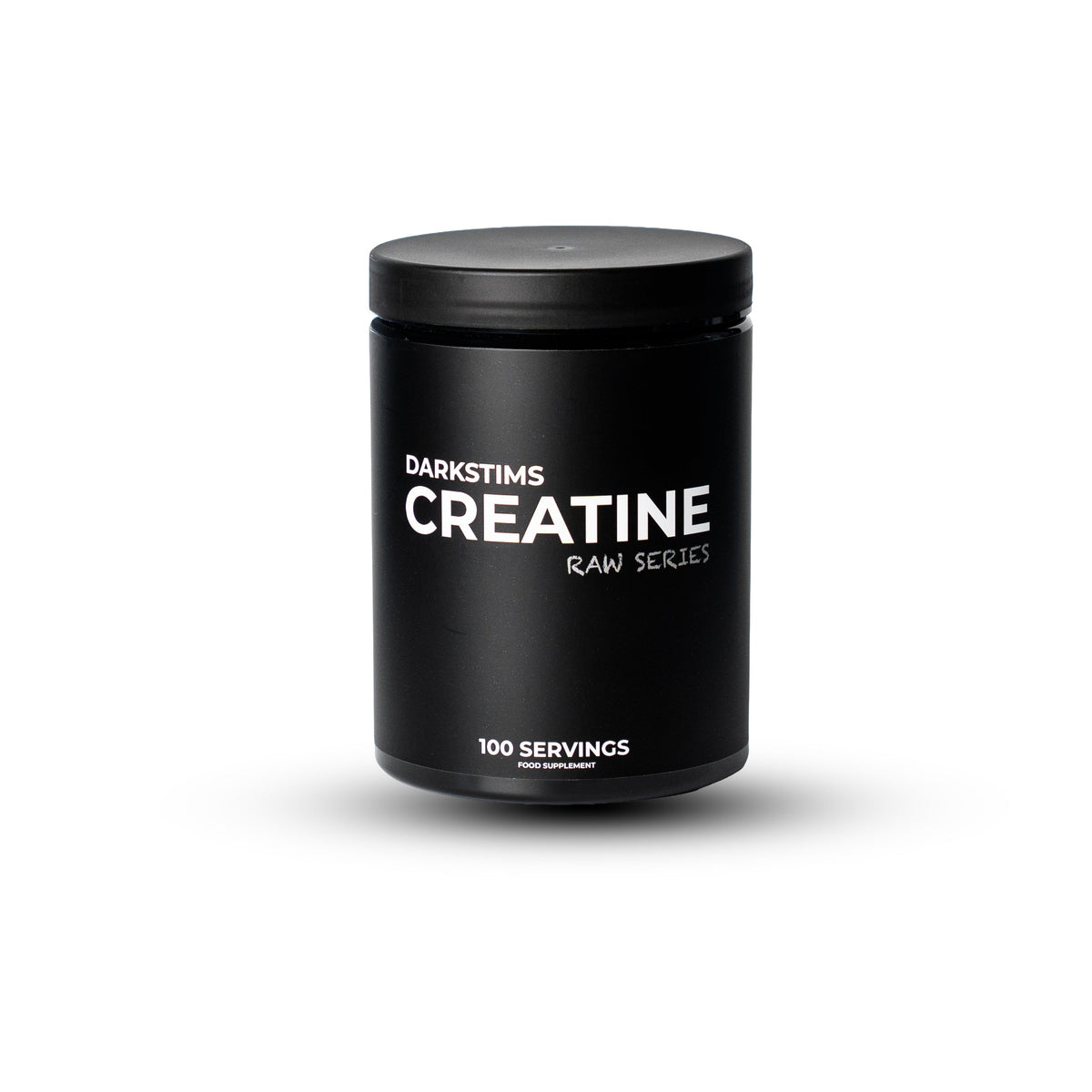
DARKSTIMS Creatine is 100% creatine monohydrate, 200 mesh and unflavoured. A 500g tub gives 100 servings of 5g, so each serving is more than the 3g daily intake linked to the authorised claim. The label directions are 5g a day at any time (or roughly 1g per 10kg of bodyweight), with an optional loading phase of 20g a day as 4 × 5g for 5–7 days, then 3–5g daily. Because it is unflavoured, it mixes into a protein shake, juice or pre-workout. It is also included in the Full Stack bundle.
FAQ
Should I take creatine on rest days?
Yes. Creatine works by keeping muscle stores full, so take your 3–5g every day, training or not. On rest days, take it with a meal.
Will creatine make me look bloated?
Most people see a small rise in scale weight, mostly in the first week and mainly if they load. That water is stored inside the muscle. To keep it to a minimum, skip loading and take 3–5g daily from the start.
Is creatine a steroid?
No. Creatine is a compound your body makes and that you eat in meat and fish. Its chemical structure is completely different from anabolic steroids, and it is legal and widely used in sport.
Can women take creatine?
Yes. The 2021 expert review found growing evidence that creatine can benefit women across the lifespan, with little to no side effects. Women who are pregnant or breastfeeding should speak to their GP first.
Sources
- Kreider RB et al. (2017). ISSN position stand: safety and efficacy of creatine supplementation in exercise, sport, and medicine. JISSN.
- Antonio J et al. (2021). Common questions and misconceptions about creatine supplementation: what does the scientific evidence really show? JISSN.
- Lak M et al. (2025). Does creatine cause hair loss? A 12-week randomized controlled trial. JISSN.
- GOV.UK. Great Britain nutrition and health claims (NHC) register.
- GOV.UK (2024). UKNHCC scientific opinion: creatine supplementation and improved cognitive function.
DARKSTIMS Creatine is a food supplement. Food supplements should not be used as a substitute for a varied, balanced diet and a healthy lifestyle. Do not exceed the stated serving. Speak to your GP before use if you are pregnant, breastfeeding, under 18, taking medication or have a medical condition, including any kidney condition.